9.4.1How can I plot a polar curve?

Graphs of Polar Equations

9-104.

PILAR’S COORDINATES

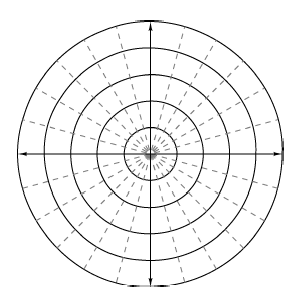
Pilar is thinking of a point on the graph at right. All she will tell you is that it is located on a ray rotated 45 counterclockwise from the positive x-axis, and 3 units from the origin.

  1. On polar graph paper, locate Pilar’s point and label it P.

  2. Given a point in polar coordinates (r,θ)r represents the distance from the pole (origin) and θ represents the counterclockwise angle from the x-axis.

    Pilar’s point can be written (3,π4). Using this polar notation, locate and label points R(2,π6) and Q(5,3π2).

  3. What happens when an angle is negative? Discuss this with your team as you place the points K(1,3π4) and L(1.5,5π3) on your graph.

  4. Pilar’s point can also be written as (3,3π4). Why?

Your teacher will provide you with a model.

9-105.

POLAR WALK

With a rope, create human graphs for the polar curves listed below. While creating the graphs, consider to the following:

  What is the shape of the curve?

  What minimum interval of θ will create a complete graph?

  1. r=6 

  1. r=9sin(θ) 

  1. r=3+7cos(θ) 

  1. r=8cos(2θ)) 

9-106.

What do you think the graph of r=5cos(θ) will look like? How will this differ from the graph of r=5cos(θ)? Check your conjecture with your graphing calculator.  

Review and Preview problems below

9-107.

The region under y=x1 over the interval 1xa for some a>1 is rotated about the line y=1. If the volume of the resulting solid is 10π cubic units, what is the value of a? Homework Help ✎

9-108.

Multiple Choice: If f(x)=3x1/34x and x1=1, then using Newton’s Method of approximating roots will result in this approximate value for x2: Homework Help ✎

  1. 0.3333 

  1. 0.5 

  1. 0.6495 

  1. 0.6496 

  1. 0.6667 

9-109.

Examine the integrals below. Consider the multiple tools available for integrating and use the best strategy for each part. Evaluate each integral and briefly describe your method. Homework Help ✎

  1. 0πsin(x)2cos(x)dx 

  1. 62|x|dx 

  1. x2e4xdx 

  1. 0xx2+4dx 

9-110.

Use the graph of y=f(x) below to sketch f(x). Homework Help ✎

Coordinate plane, x axis scaled from negative 1 to 4, y axis scaled from negative 2 to 3, Dashed vertical line at, x = 1.5, piecewise, left curve coming from upper left, concave up turning at the point (0, comma 1), continuing to infinity left of the vertical line, right curve coming from negative infinity right of the vertical line, concave down turning at the point (3, comma 0.5), continuing right & down with arrow at the point (4, comma 0).

9-111.

Calculate the area of the region which includes the origin and is bounded by the curves f(x)=x+1, g(x)=x21, and h(x)=cos1(x). Homework Help ✎

9-112.

No calculator! Evaluate the following limits. Homework Help ✎

  1. limx3x52x2+12x6+4x1 

  1. limxe2x 

  1. limx0cot(x)ln(x) 

  1. limn(k=1n(13)k) 

Compute without a calculator


9-113.

Consider each of the infinite series below. For each series, decide if it converges or diverges and justify your conclusion. If the series converges, calculate its sum. Homework Help ✎

  1. 23+13+16+112+ 

  1. 0.9+0.99+0.999+0.9999+ 

  1. 0.1+0.12+0.123+0.1234+ 

  1. 256128+6432+ 

9-114.

For each of the rectangular coordinates pairs below, write two equivalent polar coordinate pairs. Homework Help ✎

  1. (3,3) 

  1. (0,0) 

  1. (0,5) 

  1. (2,23) 

9-115.

In the diagram below, ABCD is a parallelogram. Write each of the unlabeled vectors in terms of p and q. Here is one to get you started: DC=q . Homework Help ✎

Parallelogram, A B C D, with the following rays: left side labeled, P, going from A to d, bottom side, labeled, q, going from A to b, diagonal from A to c, & diagonal from d to b.